For a Research Literature Review What Is a Primary Source
Chapter two: What is a Literature Review?
Learning Objectives
At the determination of this chapter, you will be able to:
- Recognize how information is created and how information technology evolves over time.
- Identify how the information cycle impacts the reliability of the data.
- Select information sources appropriate to information demand.
Considering a literature review is a summary and analysis of the relevant publications on a topic, we first accept to understand what is meant by 'the literature'. In this instance, 'the literature' is a collection of all of the relevant written sources on a topic. Information technology will include both theoretical and empirical works. Both types provide scope and depth to a literature review.
two.ane.1 Disciplines of knowledge
When drawing boundaries around an idea, topic, or subject field area, information technology helps to think about how and where the information for the field is produced. For this, you lot need to identify the disciplines of noesis production in a subject area.
Information does not exist in the environment similar some kind of raw material. Information technology is produced by individuals working inside a item field of knowledge who utilise specific methods for generating new information. Disciplines are knowledge-producing and -disseminating systems which consume, produce and disseminate knowledge. Looking through a course catalog of a post-secondary educational establishment gives clues to the structure of a discipline structure. Fields such as political science, biology, history and mathematics are unique disciplines, as are education and nursing, with their own logic for how and where new noesis is introduced and made accessible.
You will demand to become comfortable with identifying the disciplines that might contribute information to any search strategy. When you do this, you volition too learn how to decode the way how people talk nearly a topic within a discipline. This will exist useful to y'all when you begin a review of the literature in your area of written report.
For example, recall about the disciplines that might contribute information to a the topic such as the part of sports in lodge. Try to anticipate the blazon of perspective each field of study might have on the topic. Consider the post-obit types of questions as you examine what different disciplines might contribute:
- What is important about the topic to the people in that bailiwick?
- What is most probable to be the focus of their study most the topic?
- What perspective would they be likely to take on the topic?
In this instance, nosotros identify two disciplines that have something to say well-nigh the role of sports in club: allied wellness and pedagogy. What would each of these disciplines raise every bit key questions or issues related to that topic?
ii.1.1.i Nursing
- how sports touch on individuals' health and well-beingness
- assessing and treating sports injuries
- physical conditioning for athletes
2.1.ane.two Education
- how schools privilege or punish student athletes
- how young people are socialized into the ideal of team cooperation
- differences between boys' and girls' participation in organized sports
Nosotros see that a single topic can be approached from many dissimilar perspectives depending on how the disciplinary boundaries are drawn and how the topic is framed. This step of the enquiry process requires you to brand some decisions early on to focus the topic on a manageable and advisable scope for the balance of the strategy. (Hansen & Paul, 2015).
'The literature' consists of the published works that document a scholarly conversation in a subject field. You will find, in 'the literature,' documents that explain the background of your topic and then the reader knows where you found loose ends in the established research of the field and what led y'all to your ain project. Although your ain literature review will focus on primary, peer-reviewed resources, it will begin by starting time grounding yourself in groundwork subject information generally institute in secondary and 3rd sources such every bit books and encyclopedias. Once yous have that essential overview, you delve into the seminal literature of the field. Equally a result, while your literature review may consist of research articles tightly focused on your topic with secondary and tertiary sources used more sparingly, all three types of information (primary, secondary, tertiary) are critical to your research.
two.1.2 Definitions
- Theoretical – discusses a theory, conceptual model or framework for understanding a problem.
- Empirical – applies theory to a beliefs or event and reports derived data to findings.
- Seminal – "A classic work of research literature that is more than 5 years onetime and is marked by its uniqueness and contribution to professional cognition." (Houser, 4th ed., 2018, p. 112).
- Practical – "…accounts of how things are washed" (Wallace & Wray, 3rd ed., 2016, p. twenty). Action enquiry, in Pedagogy, refers to a wide variety of methods used to develop practical solutions. (Bully Schools Partnership, 2017).
- Policy – generally produced by policy-makers, such equally government agencies.
- Primary – published results of original research studies .
- Secondary – interpret, discuss, summarize original sources
- Tertiary – synthesize or dribble primary and secondary sources. Examples include: encyclopedias, directories, dictionaries, handbooks, guides, nomenclature, chronology, and other fact books.
- Greyness literature – research and information released past non-commercial publishers, such every bit regime agencies, policy organizations, and think-tanks.
'The literature' is published in books, journal articles, conference proceedings, theses and dissertations. Information technology tin also be found in newspapers, encyclopedias, textbooks, likewise as websites and reports written by government agencies and professional organizations. While these formats may contain what we define equally 'the literature', not all of it will be advisable for inclusion in your own literature review.
These sources are plant through dissimilar tools that we will discuss later in this section. Although a discovery tool, such as a database or catalog, may link you to the 'the literature' non every tool is appropriate to every literature review. No single source will accept all of the data resources y'all should consult. A comprehensive literature review should include searches in the following:
- Multiple subject and article databases
- Library and other book catalogs
- Grey literature sources
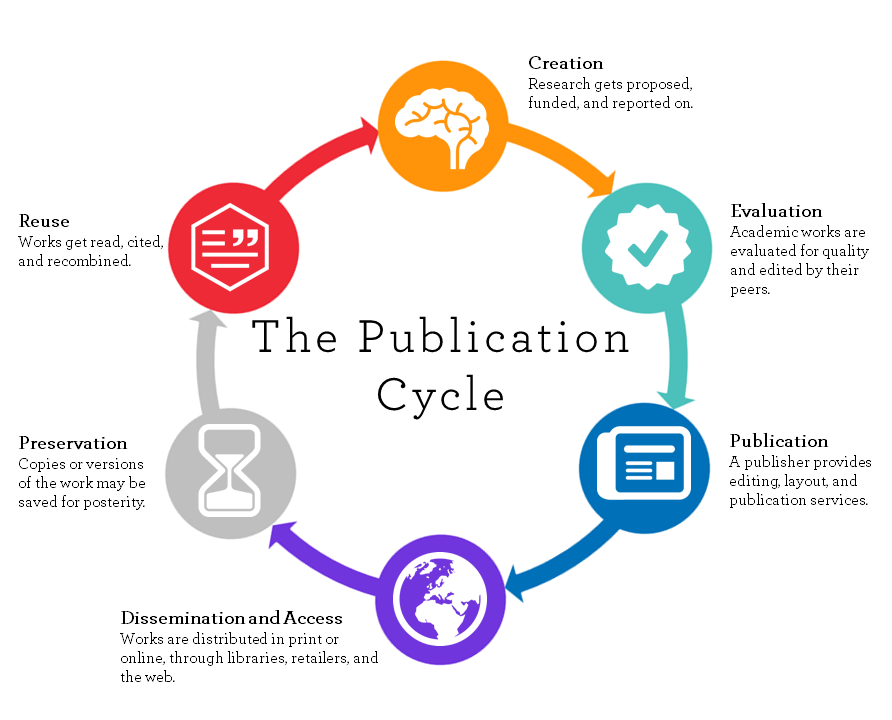
To become a amend idea of how the literature in a discipline develops, it's useful to come across how the information publication lifecycle works. These distinct stages evidence how information is created, reviewed, and distributed over time.
 Follow the epitome link to view the full tutorial.
The following chart can exist used to guide you in searching literature existing at various stages of the scholarly communication process (freely attainable sources are linked, subscription or subscribed sources are listed but non linked):
| Steps in the Scholarly Communication Procedure | Publication Bicycle | Access Points |
| Research and develop idea | Unpublished documents such as lab notebooks, personal correspondence, graphs, charts, grant proposals, and other 'grey literature' | Limited access Google Scholar HSRR (Health Services and Sciences Inquiry Resources) RePORTER (Database of NIH funded inquiry projects) Found of Education Sciences |
| Present preliminary findings | Preliminary reports: messages to the editor or journals, brief (short) advice submitted to a main journal | PubMed (limiting search results to Letter of the alphabet under Limits) Web of Science (Science Citation Index) |
| Report research | Briefing literature: preprints, briefing proceedings | PapersFirst ProceedingsFirst Briefing web sites Preprint services |
| Research reports: master'southward theses, doctoral dissertations, interim or technical reports | Dissertations & Theses British Library EThOS Theses Canada Portal Electronic Theses and Dissertations Center PubMed (limiting search results to Technical Report under Limits) Current Greyness Literature Study Professional person clan web sites OpenDOAR | |
| Publish research | Research paper (scholarly journal articles): research papers published in peer-reviewed/refereed journals | PubMed CINAHL PsycINFO Spider web of Science ERIC |
| Popularize inquiry findings | Newspapers, popular magazines, Boob tube news reports, trade publications, spider web sites | PubMed (limiting search results to News and Paper Article under Limits) Media outlets Internet search engines |
| Compact and repackage information | Reviews, systematic reviews, guidelines, textbooks, handbooks, yearbooks, encyclopedias | Cochrane Library Library Catalogs WorldCat |
To continue our discussion of information sources, in that location are two means published information in the field can be categorized:
- Articles by the blazon of journal in which an article it is published, for example, mag, trade, or scholarly publications.
- Where the fabric is located in the information cycle, equally in primary, secondary, or tertiary data sources.
ii.three.i Popular, Trade, or Scholarly publications
2.3.one.i Types of Periodicals
Journals, trade publications, and magazines are all periodicals, and articles from these publications they can all wait similar article by article when you lot are searching in the databases. Information technology is proficient to review the differences and recall about when to utilise information from each type of periodical.
2.iii.1.2 Magazines
A magazine is a collection of articles and images nearly various topics of popular involvement and current events.
Features of magazines:
- articles are commonly written by journalists
- articles are written for the boilerplate adult
- articles tend to exist short
- articles rarely provides a list of reference sources at the end of the article
- lots of color images and advertisements
- the decision nigh what goes into the magazine is made past an editor or publisher
- magazines can have broad appeal, similar Time and Newsweek, or a narrow focus, similar Sports Illustrated and Mother World News.
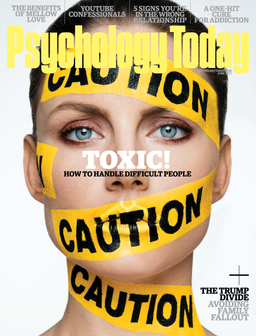
Popular magazines similar Psychology Today, Sports Illustrated, and Rolling Stone tin exist good sources for manufactures on recent events or popular-civilisation topics, while Harpers, Scientific American, and The New Commonwealth volition offering more in-depth articles on a wider range of subjects. These manufactures are geared towards readers who, although not experts, are knowledgeable about the issues presented.
2.three.ane.3 Merchandise Publications
Merchandise publications or trade journals are periodicals directed to members of a specific profession. They often have information nearly industry trends and practical information for people working in the field.
Features of trade publications:
- Authors are specialists in their fields
- Focused on members of a specific manufacture or profession
- No peer review process
- Include photographs, illustrations, charts, and graphs, often in colour
- Technical vocabulary
Trade publications are geared towards professionals in a discipline. They report news and trends in a field, merely non original inquiry. They may provide production or service reviews, task listings, and advertisements.
2.3.i.4 Scholarly, Academic, and Scientific Publications
Scholarly, bookish, and scientific publications are a collections of articles written by scholars in an academic or professional person field. Most journals are peer-reviewed or refereed, which means a panel of scholars reviews manufactures to make up one's mind if they should be accepted into a specific publication. Journal manufactures are the chief source of information for researchers and for literature reviews.
Features of journals:
- written by scholars and field of study experts
- writer' credentials and institution will be identified
- written for other scholars
- defended to a specific bailiwick that it covers in depth
- often report on original or innovative research
- long articles, oftentimes 5-15 pages or more
- articles nearly always include a listing of sources at the stop (Works Cited, References, Sources, or Bibliography) that point back to where the information was derived
- no or very few advertisements
- published by organizations or associations to advance their specialized body of cognition
Scholarly journals provider articles of involvement to experts or researchers in a discipline. An editorial board of respected scholars (peers) reviews all manufactures submitted to a journal. They make up one's mind if the article provides a noteworthy contribution to the field and should be published. In that location are typically few little or no advertisements. Articles published in scholarly journals will include a listing of references.
2.3.1.5 A discussion about open access journals
Increasingly, scholars are publishing findings and original research in open access journals.Open access journals are scholarly and peer-reviewed and open admission publishers provide unrestricted admission and unrestricted use. Open access is a means of disseminating scholarly inquiry that breaks from the traditional subscription model of academic publishing. It is free of charge to readers and considering it is online, it is available at anytime, anywhere in the globe, to anyone with admission to the internet. The Directory of Open up Admission Journals (DOAJ) indexes and provides admission to high-quality, peer-reviewed scholarly manufactures.
In summary, newspapers and other popular printing publications are useful for getting general topic ideas. Trade publications are useful for practical application in a profession and may also be a good source of keywords for hereafter searching. Scholarly journals are the conversation of the scholars who are doing research in a specific field of study and publishing their research findings.
two.3.i.half dozen Primary, Secondary, and Tertiary Sources
Primary sources of information are those types of information that come first. Some examples of master sources are:
- original enquiry, like data from an experiment with plankton.
- diaries, journals, photographs
- data from the census bureau or a survey you lot have done
- original documents, like the constitution or a birth document
- newspapers are main sources when they report current events or current opinion
- speeches, interviews, email, letters
- religious books
- personal memoirs and autobiographies
- fine art piece of work
- pottery or weavings
At that place are different types of primary sources for different disciplines. In the discipline of history, for example, a diary or transcript of a speech is a principal source. In education and nursing, primary sources will generally exist original enquiry, including information sets.
Secondary sources are written well-nigh primary sources to interpret or analyze them. They are a step or more removed from the primary event or particular. Some examples of secondary sources are:
- commentaries on speeches
- critiques of plays, journalism, or books
- a journal article that talks about a primary source such as an interpretation of Steinbeck's The Grapes of Wrath, or the blossom symbolism of Monet's water garden paintings
- textbooks (can also be considered third)
- biographies
- encyclopedias
- websites
Third sources are further removed from the original cloth and are a distillation and drove of primary and secondary sources. Some examples are:
- bibliography of critical works about an author
- textbooks (also considered secondary)
- factbooks
- guidebooks
- manuals
A comparison of information sources across disciplines:
| SUBJECT | PRIMARY | SECONDARY | TERTIARY |
| Pedagogy | Journal article reporting on quantitative study of after schoolhouse programs | Article in Instructor Magazine well-nigh after school programs | Handbook of afterschool programming ERIC database |
| Nursing | Journal article reporting on a Cclinical trial of a handling or device | Systematic review of treatment or device, such as those plant in the Cochrane Database of Systematic Reviews | Encyclopedia of Nursing Research |
| Psychology | Patient notes taken by clinical psychologist | Magazine article most the patient'due south psychological status | Textbook on clinical psychology |
In this department, we hash out how to detect non only information, only the sources of information in your subject or topic surface area. As we run across in the graphic and chart above, the information you need for your literature review will be located in multiple places. How and where research and publication occurs drives how and where the data is located, which in plow determines how y'all will discover and retrieve it. When nosotros talk about data sources for a literature review in pedagogy or nursing, we generally mean these five areas: the cyberspace, reference textile and other books, empirical or show-based manufactures in scholarly, peer-reviewed journals, conference proceedings and papers, dissertations and theses, and grey literature.
2.4.one Web
The World Wide Web can be an splendid identify to satisfy some initial enquiry needs.
- It is a good resource for background data and for finding keywords for searching in the library catalog and databases.
- It is a good tool for locating professional organizations and searching for data and the names of experts in a given discipline.
- Google Scholar is a useful discovery tool for citations, peculiarly if you are trying to get the lay of the land surrounding your topic or if you are having a trouble with keywords in the databases. Yous can discover some information to refine your search terms. Information technology is Not acceptable to depend on Google Scholar for finding articles considering of the spotty coverage and lack of adequate search features.
2.iv.2 Books and Reference Sources
Reference materials and books are bachelor in both print and electronic formats. They provide gateway cognition to a subject field and are useful at the kickoff of the enquiry procedure to:
- Get an overview of the topic, learn the scope, key definitions, significant figures who are involved, and important timelines
- Observe the foundations of a topic
- Learn essential definitions, vocabulary terms, and keywords you can use in your literature searching strategy
ii.four.3 Scholarly Articles in Journals
Another major category of information sources is scholarly data produced by subject experts working in academic institutions, research centers and scholarly organizations. Scholars and researchers generate information that advances our knowledge and understanding of the earth. The inquiry they practice creates new opportunities for inventions, applied applications, and new approaches to solving issues or understanding problems.
Academics, researchers and students at universities make their contributions to scholarly knowledge available in many forms:
- masters' theses
- doctoral dissertations
- conference papers
- journal articles and books
- private scholars' web pages
- web pages developed by the researcher'south' home establishment (Hansen & Paul, 2015).
Scholars and researchers innovate their discoveries to the globe in a formal arrangement of data dissemination that has adult over centuries. Because scholarly research undergoes a process of "peer review" before being published (meaning that other experts review the work and pass judgment virtually whether it is worthy of publication), the data you find from scholarly sources meets preset standards for accurateness, brownie and validity in that field.
Likewise, scholarly periodical articles are generally considered to be amongst the about reliable sources of data considering they have gone through a peer-review procedure.
2.4.5 Conference Papers & Proceedings
Conferences are a major source of emerging research where researchers present papers on their current enquiry and obtain feedback from the audience. The papers presented in the conference are then usually published in a book chosen a conference proceeding. Briefing proceedings highlight current discussion in a discipline and tin can atomic number 82 y'all to scholars who are interested in specific research areas.
A word about conference papers: several factors contribute to making these documents difficult to discover. It may be months before a paper is published as a journal article, or it may never be published. Publishers and professional associations are inconsistent in how they publish proceedings. For example, the papers from an annual conference may exist published as private, stand-alone titles, which may be indexed in a library catalog, or the conference proceedings may be treated more like a periodical or serial and, therefore, indexed in a periodical database.
It is not unusual that papers delivered at professional conferences are non published in print or electronic form, although an abstract may be bachelor. In these cases, the total newspaper may only be available from the author or authors.
The about important thing to recall is that if you have any difficulty finding a conference proceeding or paper, ask a librarian for assistance.
two.four.vi Dissertations and Theses
Dissertations and theses tin be rich sources of information and accept extensive reference lists to scan for resources. They are considered gray literature, so are non "peer reviewed". The accuracy and validity of the newspaper itself may depend on the school that awarded the doctoral or primary's degree to the author.
In thinking about 'the literature' of your discipline, you are beginning the first step in writing your own literature review. Past agreement what the literature in your field is, as well as how and when it is generated, you brainstorm to know what is available and where to expect for it.
Nosotros briefly discussed seven types of (sometimes overlapping) data:
- information found on the web
- information found in reference books and monographs
- information found in scholarly journals
- information found in conference proceedings and papers
- information establish in dissertations and theses
- information found in magazines and merchandise journals
- information that is primary, secondary, or tertiary.
By conceptualizing or scoping how and where the literature of your discipline or topic expanse is generated, yous have started on your style to writing your ain literature review.
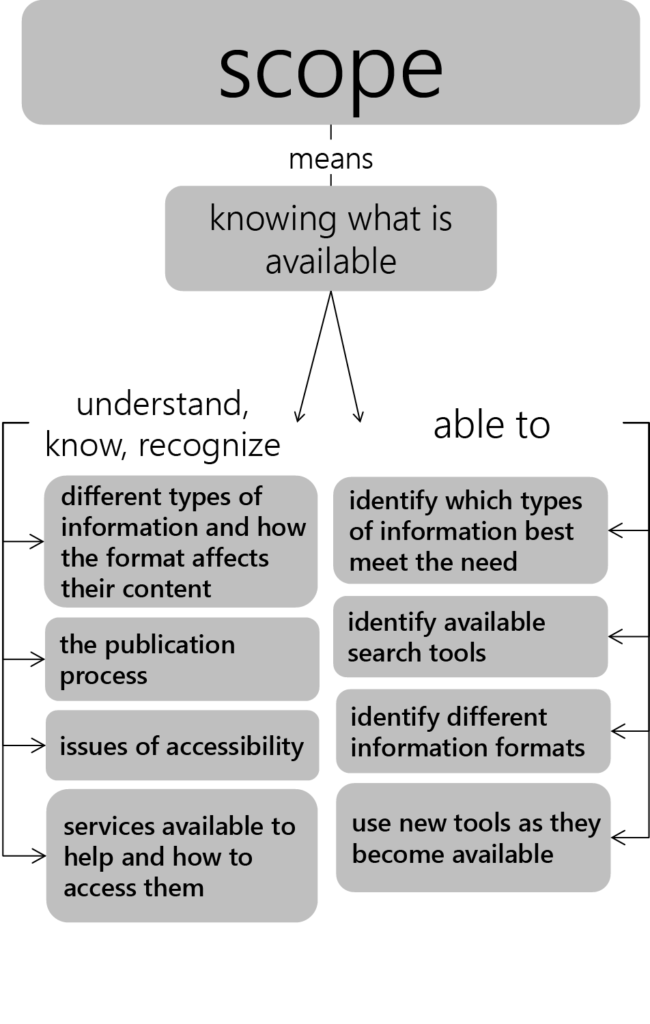
Finally, remember:
"All information sources are non created equal. Sources tin vary greatly in terms of how carefully they are researched, written, edited, and reviewed for accuracy. Common sense will assist you place plainly questionable sources, such equally tabloids that feature tales of conflicting abductions, or personal websites with glaring typos. Sometimes, however, a source'southward reliability—or lack of it—is not and so obvious…You lot volition consider criteria such as the type of source, its intended purpose and audience, the author's (or authors') qualifications, the publication's reputation, whatever indications of bias or subconscious agendas, how current the source is, and the overall quality of the writing, thinking, and design." (Writing for Success, 2015, p. 448).
We will comprehend how to evaluate sources in more than detail in Chapter 5.
Practice
For each of these information needs, indicate what resources would be the best fit to answer your question. There may be more than ane source so don't feel like you lot take to limit yourself to simply ane. See Answer Key for the correct response.
- You are to write a brief paper on a theory that you only vaguely sympathise. You lot demand some basic data. Where would you lot look?
- If you heard something on the radio about a contempo research involving an herbal intervention for weight loss where could you find the bodily report?
- You are going to be doing an internship in a group domicile for immature men. You take heard that one consequence that comes up for them is anger. Where would yous expect for practical interventions to help y'all manage this trouble if information technology came up?
- Yous have the opportunity to work on a research projection through a grant proposal. Yous need to justify the enquiry question and show that there is an interest and a need for this inquiry. What resources would you cite in your application?
- You accept been assigned a project to find master sources about classroom subject area used in early on 20th-century schools. What primary sources could you use and where would you notice them?
- You lot have an thought for a great thesis but you lot are afraid that it has been done before. Since yous would like to practise something original, where could you find out if someone else has done the project?
- At that place was a post on Facebook that welfare recipients in Arizona were recently tested for drug use with only three in 140,000 having positive results. Where can I observe out if this number is accurate?
Examination Yourself
Question one Match the blazon of periodical to its content
Trade publication
Scholarly periodical
Magazine
- Contains articles about a variety of topics of popular interest; too contains advertising.
- Has information about manufacture trends and applied information for professionals in a field.
- Contains articles written by scholars in an academic field and reviewed by experts in that field.
Question two: Given what you lot know about information types and sources, put the following data sources in society from the to the lowest degree accurate and reliable to the most accurate and reliable. (1 least accurate/4 nigh accurate)
- Books and encyclopedias
- News broadcasts and social media straight following an event.
- Analysis of an event in the news media or popular mag weeks after an effect.
- Articles written past scholars and published in a journal.
Question 3: What is information chosen that is either a diary, a oral communication, original research, data, artwork, or a religious book.
- Primary
- Secondary
- Third
- Empirical
Question 4: To find the best data in the databases you demand to apply keywords that are used past the scholars. Where do yous find out what keywords to endeavour?
- From websites
- In journal articles
- In Books
- All of the above
Question 5: Which of the following is NOT true well-nigh scholarly journals?
- They comprise the conversation of the scholars on a item subject.
- They are of interest to the general public.
- The manufactures are followed past an extensive reference listing.
- They contain reports of original research.
Source: https://press.rebus.community/literaturereviewsedunursing/chapter/chapter-2-what-is-a-literature-review/

Post a Comment for "For a Research Literature Review What Is a Primary Source"