what iv push meds need to be given slowly
Chapter 7. Parenteral Medication Administration
7.vi Intravenous Medications by Direct IV (Formerly 4 Push)
In the past, 4 medications given equally described above were referred to as 4 bolus or Four push button medications. It is recommended that these terms NOT exist used, as they tin can be mistakenly interpreted as meaning the drugs are to be pushed quickly, in less than a minute (ISMP, 2003). To administrate IV medications safely and finer, nurses must follow all bureau policies and apply PDTM guidelines to determine which medications can exist given intravenously and whatever specific instructions most assistants (Alberta Health Services, 2009).
Intravenous (IV) is a road for administering concentrated medications (diluted or undiluted) directly into the vein. Depending on the medication and the purpose, meds given Four may be through continuous infusions, mini-numberless, or more quickly past what is referred to every bit straight Four. The Four directly route refers to the assistants of a small volume of fluid / medication (max. xx ml) pushed manually into the patient using a syringe Leur locked to a needleless port. Medications given by direct IV are usually administered intermittently to treat emergent concerns. Medications administered by straight IV road are given very slowly over at least one minute (Perry et al., 2014). The nurse must consult drug monographs and / or Parenteral Drug Therapy Manual (PDTM) for specifics most each medication. Administering a medication intravenously eliminates the process of drug kickoff pass by depositing the medication directly into the blood. This results in the immediate summit of serum drug levels and loftier drug concentrations in vital organs, such every bit the eye, brain and kidneys. Both therapeutic and adverse furnishings tin occur rapidly with 4 directly administration (Alberta Health Services, 2009).
There are many advantages and disadvantages to administering medications via the intravenous injection method—come across Table 7.7.
Table 7.seven Advantages and Disadvantages of Intravenous Medications | |||
Advantages | Disadvantages | ||
| Intravenous medications can deliver an immediate, fast-acting therapeutic outcome, which is important in emergent situations such as cardiac abort or narcotic overdose. They are useful to manage hurting and nausea by rapidly achieving therapeutic levels, and they are more consistently and completely captivated compared with medications given by other routes of injection. | One time an intravenous medication is delivered, it cannot exist retrieved. When giving IV medications, there is very little opportunity to stop an injection if an adverse reaction or fault occurs. Four medications, if given too quickly or incorrectly, can cause significant harm or expiry. | ||
| Doses of short-acting medication can be titrated according to patient responses to drug therapy. Medication can be prepared quickly, and given over a shorter period of time compared to the Four piggyback road. | Any toxic or agin reaction volition occur immediately and may be exacerbated by a apace injected medication. | ||
| Minimal dilution is required for some medications, which is desirable for patient's own fluid restrictions. | Extravasation of certain medications into surrounding tissues tin can cause tissue impairment, nerve impairment, and scarring. | ||
| There is minimal or no discomfort for the patient in comparing to SC and IM injections. | Not all medications can be given via the direct IV road. | ||
| They provide an alternative to the oral route for drugs that may not be absorbed by the GI tract, and they are platonic for patients with GI dysfunction or malabsorption, and patients who are NPO (nothing by mouth) or unconscious. | In that location is a high adventure for infusion reactions, balmy to astringent, considering most 4 medications peak chop-chop (i.e., they accept a quick onset of upshot). A hypersensitivity reaction can occur immediately or exist delayed, and requires supportive measures. | ||
| Four directly route provides a more accurate dose of medication considering none is left in the intravenous tubing. | Road for administering medications may damage surrounding tissues. There is an increased gamble of phlebitis with highly concentrated medication, especially with small-scale peripheral veins or a short venous access device. | ||
| Data source: Albert Health Services, 2009; Lynn, 2011; Perry et al., 2018 | |||
Intravenous medications are ever prepared using the 7 rights and 3 checks as per agency policy. Considering of the high risk associated with straight intravenous medications, additional guidelines are required. A PDTM or drug monograph provides additional data to help the nurse make decisions about administering Four medications. Some medications tin be given either Four straight or piggyback, in which case the nurse must use their knowledge near the patient to determine which of these is preferred. Some medications may only be given in large-volume 4 solutions; some medications have to be diluted; some medications accept to be administered over specific time frames (i.east., over 1 or ii minutes). In improver, information regarding indications, contraindications, dosage (historic period dependent), administration/dilution guidelines, adverse effects, clinical indications (e.g., specialized monitoring required, must be on an IV pump), compatibility and incompatibility in relation to reconstitution and primary Iv solution is specified (Alberta Wellness Services, 2009).
The Institute for Rubber Medication Practices (ISMP) (2014) has created a list of high-warning medications that bear the heightened risk of pregnant harm when they are used in error. Special safeguards for these medications can be institute in the PDTM. Information technology is vital to understand which medications are considered high risk prior to administration. A link to the listing of high-risk medications tin can be found under Suggested Online Resource at the end of this chapter. Review the steps shown in Table seven.8 to prepare a medication past direct Iv route. The PDTM must be consulted every time an Iv medication is given, as retentiveness-based errors are common (World Wellness Organization, 2012).
Tabular array vii.viii Grooming Questions for Intravenous Medications | |||
Safety considerations:
| |||
Principle | Additional Information | ||
| Verify qualifications for administration. | Are you qualified to requite this medication? What supervision is required? What resources must you consult? | ||
| Review route of assistants and IV site. | Can this medication be given by the IV road? Is the route of administration (needle insertion site) gratis from redness, swelling, and discomfort? | ||
| Review training and how to administer the medication. | How is this medication given by the IV route (diluted or undiluted)? Describe the safest mode to prepare the medication. Consider the selection of medication. Always employ less-concentrated solutions whenever possible. Does the medication crave dilution? If diluting the medication, E'er discard (that is, waste) the unused portion before going to the bedside.
| ||
| Place when a medication starts to work. | What is the onset, height, and elapsing of the medication? | ||
| Appraise dose and range (east.g., 5 to x mg). | Is the ordered dose safe? When did the patient last receive this medication? What was the consequence of the medication on the patient? | ||
| Understand the therapeutic outcome. | What is the expected therapeutic consequence of the medication? What cess is necessary to determine if the medication is right for the patient? | ||
| Know adverse effects. | What are the potential adverse effects of the medications? How would yous manage these adverse furnishings? Is there an antidote? | ||
| Know potential incompatibilities. | Are at that place any potential incompatibilities with existing Iv solutions? How would you manage these bug? Is a secondary medication currently running? Are in that location additives to the 4 solution? | ||
| Know how to complete the process. | How do you complete this procedure? Is a mail service-saline lock flush required? | ||
| Document procedure. | How and where practice you chart this medication: pain assessment sheet, MAR, etc.? | ||
| Data source: BCIT, 2015; Berman & Snyder, 2016; Clayton et al., 2010; WHO, 2012 | |||
Earlier giving an intravenous medication, always assess the Four insertion site for patency and for signs of infiltration or phlebitis. Start a new 4 site if current site is red, swollen, or painful when flushing. Intravenous medications past direct IV road tin can be given 3 ways:
- Through an Iv that is capped / locked.
- Through an 4 that has an infusion running and the medication is compatible with the IV solution.
- Through an IV that has an infusion running and the medication is incompatible with the IV solution.
Checklist 60 reviews the steps to administrate a medication 4 direct into a locked / capped 4. Review the preparation questions for intravenous medication in Table 7.viii prior to administering medication.
Checklist 60: Administering Medications IV Direct into a Locked / Capped Iv (PVAD Short, Midline, PICC, Percutaneous Non-Hemodialysis CVC)Disclaimer: Ever review and follow your agency policy regarding this specific skill. | |||
Prophylactic considerations:
| |||
Steps | Additional Information | ||
| 1. Fix one medication for one patient at the right time as per bureau policy. Review the medico's order, PDTM, and MAR for the right order and guidelines. Math calculations may be required to make up one's mind the correct dose to set the medication. | Always utilize the SEVEN rights and THREE checks of medication administration. Review the agency policy if a medication is a stat, given for the first time, a loading dose, or a one-time dose. Some agencies require that high-alert medications be double-checked by a second wellness care provider. Always follow agency policies. For a list of loftier-alert medications, encounter Suggested Online Resource. After preparing the medication, always label the medication syringe with two patient identifiers (name & date of birth), engagement, time, medication, dose (ie. ii mg), and your initials. Never leave the medication syringe unattended. | ||
| 2. Create privacy if possible. | This provides comfort to patient. | ||
| 3. Confirm patient ID using two patient identifiers (e.g., name and date of nascence) AND compare the MAR with the patient's wristband to confirm patient ID. | This ensures y'all have the right patient and complies with agency standard for patient identification. 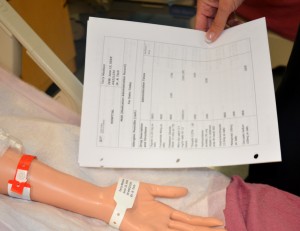 | ||
| 4. Cheque allergy band for any allergies, and enquire patient virtually type and severity of reaction. | This ensures allergy status is correct on the MAR and on patient's allergy band. | ||
| 5. Discuss purpose, action, and possible side effects of the medication. Provide patient an opportunity to ask questions. Encourage patient to report discomfort at the Iv site (pain, swelling, or burning). | Keeping the patient informed of what is being administered helps decrease anxiety. | ||
| 6. Perform mitt hygiene | Hand hygiene prevents the transmission of microorganisms. | ||
| 7. Assess IV insertion site for complications. See Checklist 65. Clean access port / needleless cap using alcohol and friction for 15 seconds. Let to dry. | Alcohol and friction sanitizes. Allowing alcohol to dry out renders the clarified properties effective. Cleaning access ports earlier each syringe is fastened and after each syringe is detached reduces gamble of infection. 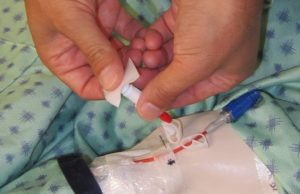 | ||
| 8. Luer lock 10 ml saline filled syringe onto needleless cap. Release clench on extension tubing if present. | 10 ml syringes for flushing reduces risk of fracturing the Iv cannula. 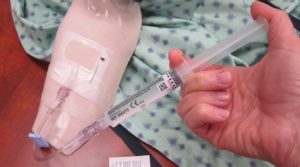 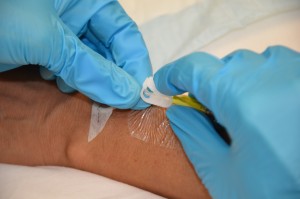 Refer to agency guidelines for VAD flushing & locking protocols. | ||
| nine. Verify patency of the line. PVAD short:
Midline, CVC (PICC / percutaneous not-hemodialysis line):
Remove syringe. | PVAD short: if swelling, pain, or redness exists, remove IV cannula and reestablish new 4 site. Tenderness is the first sign of phlebitis. Aspirating on a PVAD short oft does non reveal claret flashback despite the site being patent. Assess for patency of PVAD short during the flush past assessing for resistance, pain, and leaking. If y'all doubtable the line is not patent, STOP. DO NOT forward affluent. Remove the PVAD short and reestablish a new 1. Turbulent flush is a end get-go vigorous motion intended to clean the inside lumen of the VAD. Aspirating on a PICC, midline, and percutaneous not-hemodialysis CVC should reveal claret flashback. If yous suspect the line is not patent, or partially occluded, follow agency guidelines (this usually involves trouble shooting and / or consulting the IV squad / PICC nurse for declotting). If possible, aspirate simply until flashback of blood is into the catheter. Flashback into syringe creates more hazard for occlusion if not flushed correctly. | ||
| 10. Clean access port with booze and friction for 15 seconds. Luer lock medication syringe to needleless cap. | Cleaning access ports before each syringe is attached and afterward each syringe is detached reduces run a risk of infection. Using a needleless system prevents needle-stick injuries. Use 10 ml syringe (minimum) to reduce risk of catheter fracture. 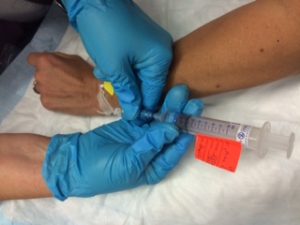 | ||
| 11. Use a timer / sentinel / clock to inject medication at the correct charge per unit according to agency policy. Administer the medication slowly and steadily. Effort to have one-half of the syringe emptied in half of the recommended infusion time. | Timing of the administration promotes safer medication administration. Rapid injection of IV medications can have serious consequences for the patient. 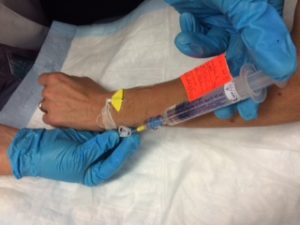 | ||
| 12. Remove empty medication syringe. Clean access port using booze and friction for 15 seconds. Luer lock x ml saline filled syringe to the needleless cap. Affluent with volume directed by agency 's flushing protocol at the SAME rate as the medication commitment, according to guidelines found in the PDTM. (Meet Rationale for Flushing with NS after Administering an 4 Medication) Ensure the final flush is done in a style that ensures positive pressure level is achieved. This will depend on what kind of needleless cap and what kind of saline filled syringe is available to you. See Positive Pressure. | Cleaning access ports before each syringe is attached and after each syringe is detached reduces risk of infection. Cheque agency flushing protocol for flushing book. Flushing the Four line at the same rate every bit medication delivery ensures that whatever medication remaining within the Four line is delivered at the correct rate, and avoids the patient receiving an accidental bolus of the medication. 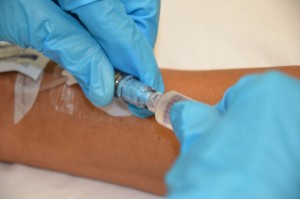 Flushing the extension tubing clears the medication from the device. 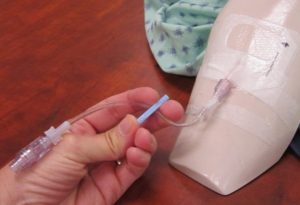 Note: If a patient has a fundamental venous catheter, follow agency protocols for accessing and flushing and locking. E'er assess IV sites earlier and after assistants of IV medications. | ||
| 13. Dispose of all syringes, blunt fill needles, blunt fill filter needles according to agency policy. | This prevents adventitious needle-stick injuries. | ||
| 14. Perform manus hygiene. | This reduces transmission of microorganisms. | ||
| 15. Document as per agency protocol. | Document the time, reason, drug, dose, effect, and any adverse reactions. | ||
| sixteen. Discover for expected therapeutic effect and for adverse effects. | The patient needs to be evaluated and monitored, especially for high-warning medications. IV medications act quickly. | ||
| Data source: Canadian Found for Wellness Data, 2009; Clayton et al., 2010; Goossens, 2015; Perry et al., 2018 | |||
Watch the video: Administering Medications: Directly IV – Into a Locked IV (PVAD short) by Renée Anderson & Wendy McKenzie Thompson Rivers University
Special considerations when giving meds Iv:
- Top contributing factors to medication errors include calculation errors, drug preparation errors, human fault, and transcription inaccuracy.
- The elderly and the young may be more sensitive to adverse effects.
- With certain medications, creatinine clearance must exist assessed prior to administering. Patients with liver affliction may crave a reduction in dosages.
- When a medication dose is ordered with a range (e.g., morphine 2 mg Iv q 2-4 hours p.r.n.), always beginning with the everyman dose and titrate up. Ever assess when the last dose was given and its effectiveness.
Considerations for Saline Flushes after Four Medication Assistants
- The normal saline flush afterward 4 meds are administered serves a few purposes: one) to deliver whatever medication left in the tubing in to the patient; 2) to reduce hazard of residue – medications / Iv solutions / fibrin- build up in the lumen of the Iv cannula (Gossens, 2015); and iii) to constitute an environment inside the Iv cannula to prevent reflux of blood and / or clotting of the VAD if it is to remain locked
- When meds are given Four direct, some medication remains in the tubing between the admission port and the end of the IV cannula. Equally such care must be taken to complete the flush in a style that does non result in a bolus of medication being administered too chop-chop. Sudden boluses of some medications may cause mild to severe adverse effects, such as hypotension and toxicity (Clayton et al., 2010).
- The flushing solution must be compatible with other Iv solutions / meds
- Turbulent affluent is a stop start motility intended to cleanse the inside lumen of the Iv cannula.
- Loftier PSI (pounds per square inch) can fracture an 4 cannula. Ever utilise the manufacturers guidelines for choosing the syringe size (usually 10 ml).
- Refer to flushing protocols. Open up concluded CVADs require heparin later on the saline flush to reduce risk of clotting.
Here are some examples of clearing IV medication from the extension tubing on a PVAD short saline lock.
- If morphine (1 mg) is administered over one minute, the subsequent saline flush volition be given in this mode: the first 1 ml of a 5 ml saline flush will be delivered over one infinitesimal to articulate the medication from the tubing, and the remaining 4 ml volition be the turbulent flush.
- If furosemide (40 mg) is given in a 4 ml volume and administered over 2 minutes, the subsequent saline affluent volition be given in this manner: the first one ml of a 5 ml saline affluent will be delivered over 30 seconds, and the remaining 4 ml will be the turbulent affluent.
Checklist 61 lists the steps to administering an IV medication through an existing IV line with compatible IV solution. Review the grooming questions for intravenous medication in Table 7.8 prior to the medication administration.
Checklist 61: Administering medications IV directly into an infusing IV – with compatible solution (PVAD brusque, midline, PICC, percutaneous non-hemodialysis CVC)Disclaimer: Always review and follow your agency policy regarding this specific skill. | |||
Safety considerations:
| |||
Steps | Additional Information | ||
| 1. Prepare ane medication for one patient at the correct time as per bureau policy. Review the doc's order, PDTM, and MAR for the right order and guidelines. Math calculations may be required to decide the correct dose to gear up the medication. Determine compatibilities of the medication to be given with the primary Four solution. If the main solution contains medication that should not be stopped (e.k., heparin, morphine, pantoprazole, insulin, or blood or claret products),do not utilize this line. In this case establish another IV access. | Always utilize the SEVEN rights and THREE checks of medication administration. Review the agency policy if a medication is a stat, showtime-fourth dimension, loading dose, or a sometime dose. Some agencies require high-alert medications to be double-checked by a second health care provider. Always follow agency policies. Afterwards preparing the medication, always label the medication syringe with two patient identifiers, date, time, medication, dose (e.g., morphine 2 mg), and your initials. Never leave the syringe unattended. If medications given simultaneously are incompatible, the mixing of these tin can create precipitates in the IV tubing which tin initiate emboli formation in the blood. Stopping infusions that containing medications interrupts delivery of that medication. Blood and blood products are NOT compatible with Whatsoever medication. | ||
| 2. Create privacy if possible. | This provides comfort to patient. | ||
| 3. Ostend patient ID using two patient identifiers (e.grand., name and date of nascency) AND compare the MAR printout with the patient'southward wristband to confirm patient ID. | This ensures you have the right patient and complies with agency standard for patient identification. 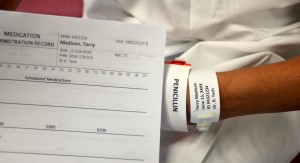 | ||
| 4. Cheque allergy band for any allergies, and ask patient about blazon and severity of reaction. | This ensures allergy status is correct on the MAR and on patient allergy band. | ||
| five. Discuss purpose, activity, and possible side furnishings of the medication. Provide patient an opportunity to ask questions. Encourage patient to study discomfort at the 4 site (pain, swelling, or called-for). | Keeping patient informed of what is beingness administered helps subtract anxiety. | ||
| half-dozen. Perform hand hygiene | Prevents the transmission of microorganisms. | ||
| 7. Appraise IV insertion site. Meet Checklist 65. | Redness, swelling and leaking advise complications. | ||
viii. Select Iv access port closest to the patient. Clean admission port using friction with an alcohol swab for fifteen seconds. Allow to dry. 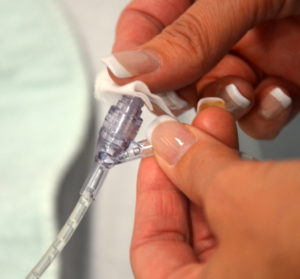 | The closest port allows the medication to reach the blood stream quickly. Cleaning access ports before each syringe is attached and after each syringe is detached reduces run a risk of infection. Alcohol and friction sanitizes. Allowing alcohol to dry renders the antiseptic properties effective. Refer to agency guidelines for VAD flushing & locking protocols. | ||
| 9. Stop the infusion. | Stopping the infusion for an Iv run past gravity involves clamping a slide clamp distal to the access port or rolling the roller clamp to the closed position OR folding the tubing on itself and pinching information technology. Stopping the infusion for an Iv run past an EID / pump simply involves stopping the automobile. | ||
| 10. Verify site patency. Luer lock a x ml saline filled syringe to the access port closest to the patient. Aspirate and assess for blood flashback in the line. Forward affluent x ml normal saline syringe using turbulent technique. THIS IS THE Flush PRIOR. | Checking patency of PVAD short: you tin aspirate… or not. Likely you can assess patency through observation of the site with an infusing IV. PVAD short sites that are not patent may be edematous (suggests infiltration), may not be infusing (observe for drops in the drip chamber) or the EIDs / IV pumps alerts presence of an occlusion. Checking patency of midline, CVC (PICC / non-hemodialysis line): aspirate for blood return. When blood flashback present in tubing, forward affluent using turbulent technique. If there is no blood return, problem shoot according to bureau protocol and / or contact the 4 team / PICC nurse for farther cess. Using a needleless system prevents needle-stick injuries. New recommendations include flushing before AND after medication administration. x ml syringes decrease adventure of catheter fracture. Flushing the line clears aspirated blood and reduces risk of clotting and occlusion. Turbulent flush cleans 4 lumen of medication remainder and fibrin. Exercise NOT force if resistance is felt. | ||
| xi. Remove syringe. Make clean IV access port for 15 seconds with alcohol and friction. Permit to dry out. Luer lock medication syringe to the access port. | Cleaning access ports before each syringe is attached and afterwards each syringe is detached reduces risk of infection. | ||
| 12. Inject medication at the recommended rate according to PDTM. Utilise a timer / watch / clock to monitor time. Administrate the medication slow and steady. Attempt to have one-half of the syringe emptied in half of the recommended infusion time. | Timing of the administration promotes safer medication commitment. Rapid injection of 4 medications tin can have serious consequences for the patient | ||
| thirteen. Remove empty medication syringe. Clean port using alcohol and friction. Luer lock a 10 ml saline filled syringe to the access port. Flush with volume directed by agency flushing protocol at the Same rate equally the medication commitment, co-ordinate to guidelines establish in the PDTM. (See Rationale for Flushing with NS after Administering an IV Medication.) THIS IS THE Flush AFTER. Resume the infusion. | 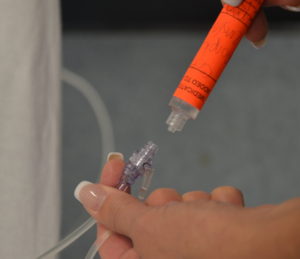 Alcohol and friction sanitizes. Allowing alcohol to dry renders the antiseptic backdrop constructive. Cleaning access ports earlier each syringe is attached and after each syringe is detached reduces risk of infection. The last affluent does NOT take to ensure positive pressure is achieved because the infusion volition be resumed. Always assess IV sites before and after administration of Iv medications. | ||
| 14. Dispose of all syringes, and blunt fills and blunt fill filters as per agency protocol. | Blunt fill and edgeless make full filters are disposed of in sharps containers to prevent accidental needle-stick injury. | ||
| 15. Perform mitt hygiene. | This reduces transmission of microorganisms. | ||
| xvi. Certificate as per agency protocol. | Certificate fourth dimension, reason, drug, dose, therapeutic effect, and whatever adverse reactions. | ||
| 17. Evaluate the patient for therapeutic effect and adverse reactions according to appropriate time frame (onset and acme of medication). | Observations provide additional safety measures, especially for loftier-alert medications. Iv medications act speedily. | ||
| Data source: Berman & Snyder, 2016; Canadian Establish for Wellness Information, 2009; Clayton et al., 2010; Perry et al., 2018; Workers Compensation Act, 2015 | |||
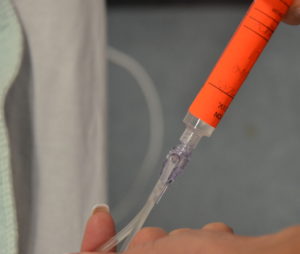
Picket the video: Administering Medications: Direct Iv – Into an 4 with an Infusionby Renée Anderson & Wendy McKenzie Thompson Rivers University
Checklist 62 reviews the steps to administer an 4 medication through an existing 4 line with incompatible IV solution. Review the grooming questions for intravenous medication in Table 7.8 prior to the medication administration.
Checklist 62: Administering Medications IV Direct into an Infusing Four with Incompatible IV Solution (PVAD Short, Midline, PICC, Percutaneous Non-Hemodialysis CVC)Disclaimer: Always review and follow your bureau policy regarding this specific skill. | |||
Safe considerations:
| |||
Steps | Additional Information | ||
| one. Prepare one medication for 1 patient at the correct fourth dimension as per agency policy. Review the medico orders, PDTM, and MAR for the correct guild and guidelines. Math calculations may exist required to make up one's mind the correct dose to prepare the medication. E'er bank check agency policy to ensure an 4 solution or medication tin be stopped temporarily (i.due east., longer than it takes to check patency).Some IV solutions (i.due east., those with medications in the chief solution—insulin, heparin) tin non be stopped. If unable to temporarily stop an IV solution or IV medication, plant a new IV access at a different site. | Ever apply the Seven rights THREE checks of medication administration. Review the bureau policy if a medication is a stat, outset-time, loading dose, or a one-time dose. Some agencies crave that high-warning medications be double-checked by a second wellness intendance provider. Ever follow agency policies. Afterwards preparing the medication, always label the medication syringe with 2 patient identifiers, date, time, medication and dose (e.yard., morphine 2 mg), dose, and your initials. Never leave the syringe unattended. | ||
| 2. Create privacy if possible. | This provides comfort to patient. | ||
| three. Ostend patient ID using two patient identifiers (east.one thousand., name and appointment of nascence) AND compare the MAR printout with the patient's wristband to confirm patient ID. | This ensures you have the correct patient and complies with agency standard for patient identification. | ||
| 4. Check allergy band for any allergies, and enquire patient about blazon and severity of reaction. | This ensures allergy status is right on the MAR and on patient allergy ring. | ||
| 5. Discuss purpose, action, and possible side effects of the medication. Provide patient an opportunity to ask questions. Encourage patient to report discomfort at the Iv site (hurting, swelling, or burning). | Keeping patient informed of what is existence administered helps decrease anxiety. | ||
| 6. Perform hand hygiene | Hand hygiene prevents the transmission of microorganisms. | ||
| 7. Assess IV insertion site. See Checklist 65 | Redness, swelling and leaking advise complications. | ||
| 8. Select 4 access port closest to the patient. Clean access port using friction with an alcohol swab for xv seconds. Allow to dry. | The closest port allows the medication to attain the claret stream quickly. Cleaning access ports earlier each syringe is attached and after each syringe is detached reduces risk of infection. Alcohol and friction sanitizes. Allowing alcohol to dry renders the antiseptic properties effective. Refer to agency guidelines for VAD flushing & locking protocols. | ||
| 9. Stop the infusion. | Stopping the infusion for an 4 run by gravity involves clamping a slide clamp distal to the access port or rolling the roller clench to the airtight position OR fold the tubing on itself and pinch Stopping the infusion for an Four run past an EID / pump simply involves stopping the car. | ||
| x. Verify site patency Luer lock a ten ml saline filled syringe to the access port closest to the patient. Aspirate and appraise for blood flashback in the line. Forward flush 10 ml syringe using turbulent technique. THIS FLUSH Will CLEAR THE LINE OF THE INCOMPATIBLE MEDICATION. | Checking patency of PVAD brusk: you can aspirate… or not. Likely you tin can assess patency through observation of the site with an infusing Four. PVAD short sites that are not patent may be edematous (suggests infiltration) or non infusing (notice for drops in the drip chamber); or the IV pump indicates occlusion. Checking patency of midline, CVC (PICC / non-hemodialysis line): aspirate for blood render. When blood flashback is present in tubing, forward flush using turbulent technique. If at that place is no blood return, trouble shoot according to bureau protocol and / or contact the 4 team / PICC nurse for farther assessment. Using a needleless organization prevents needle-stick injuries. ten ml syringes subtract risk of catheter fracture. Flushing the line clears aspirated blood and reduces adventure of clotting and occlusion and it clears the line of incompatible medication. Turbulent flush cleans IV lumen of medication residuum and fibrin. Do Not strength if resistance is felt. | ||
| 11. Remove syringe. Clean IV access port for 15 seconds with booze and friction. Allow to dry out. | Cleaning access ports before each syringe is fastened and after each syringe is detached reduces risk of infection. The IV line must remain clamped (shut off) to avoid accidental mixing of incompatible IV solution and the medication. | ||
| 12. Leur lock the medication syringe to the access port. Inject medication at the recommended rate co-ordinate to PDTM. Utilise a timer / lookout / clock to monitor time. Administer the medication boring and steady. Attempt to have half of the syringe emptied in half of the recommended infusion time. Remove empty syringe. Clean port for 15 seconds using booze and friction. Adhere a 10 ml normal saline syringe. Flush with volume directed past agency flushing protocol at the SAME rate as the medication delivery, according to guidelines plant in the PDTM. (See Rationale for Flushing with NS later on Administering an IV Medication.) THIS Flush REMOVES MEDICATION FROM THE TUBING. | This ensures prophylactic medication administration at the correct rate. Rapid injection of Four medications can take serious consequences for the patient Always assess IV sites earlier and after administration of IV medications. This step delivers the medication that remains in the Four tubing at the same rate, and prevents patient from accidentally receiving a bolus of the medication. It also clears the Four line to forbid any mixing of incompatible medication with the IV solution. The IV line must remain clamped to avert accidental mixing of incompatible IV solution and the medication. | ||
xiii. Resume the IV infusion
Appraise the Iv site. | 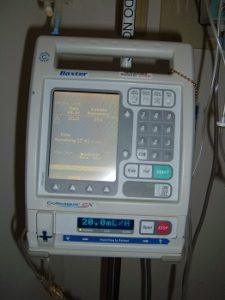 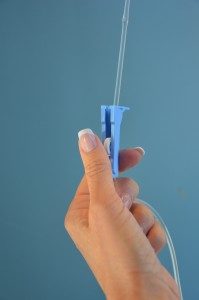 Resume the IV infusion | ||
| 14. Dispose of all syringes and blunt fills and edgeless fill filters as per agency protocol. Perform hand hygiene. | Blunt fill and blunt fill up filters are disposed of in sharps containers to prevent accidental needle-stick injury. This reduces the transmission of microorganisms. | ||
| 15. Evaluate the patient'south response to the medication in the appropriate fourth dimension frame. Document according to bureau protocol | Observe patient for expected therapeutic effects and adverse reactions. Observations provide boosted prophylactic measures, especially for high-warning medications. 4 medications act rapidly. | ||
| Data source: Berman & Snyder, 2016; Canadian Found for Health Information, 2009; Clayton et al., 2010; Perry et al., 2014 | |||
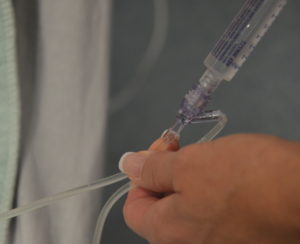
Source: https://pressbooks.bccampus.ca/clinicalproceduresforsaferpatientcaretrubscn/chapter/7-6-intravenous-medications-by-direct-iv-formerly-iv-push/

Post a Comment for "what iv push meds need to be given slowly"